Eco-Literate Pedagogy
  • Blog
  • Dictionary
  • Music Lessons for a Living Planet (2024)
  • Eco-Literate Music Pedagogy (2017)
  • Classical
  • Songs for Eco-Literacy
    • Listening for Eco-Literacy
    • Choir for Eco-Literacy
    • Band for Eco-Literacy
    • School Orchestra for Eco-Literacy
    • Pieces my Students Brought to my Attention
  • Relevant Music Education Articles
  • Relevant Internet Sites
  • Lessons
  • Philosophical Statement
  • Eco-Literate Music Pedagogy (2017)
  • Recent Presentations and Papers

On the Brilliance of Bird-Brains

3/4/2021

0 Comments

 
Picture
Post 77.

A reflection: This morning house finches and sparrows abound in my yard, creating a soundscape that is a work of art. Not like a work of art. Is. Their brains, bird-brains, so unlike my own brain, nonetheless enters into aesthetic conversation with me. Enfolding me. Though the term aesthetic has come to be, on the positive end, connected with beauty; and on the negative end, linked to the colonial dominance of a class of Western elites who consumed classical music, the word itself emerges from the ancient Greek aisthētikós, which, instead, refers to sense perception. That which can be sensed.

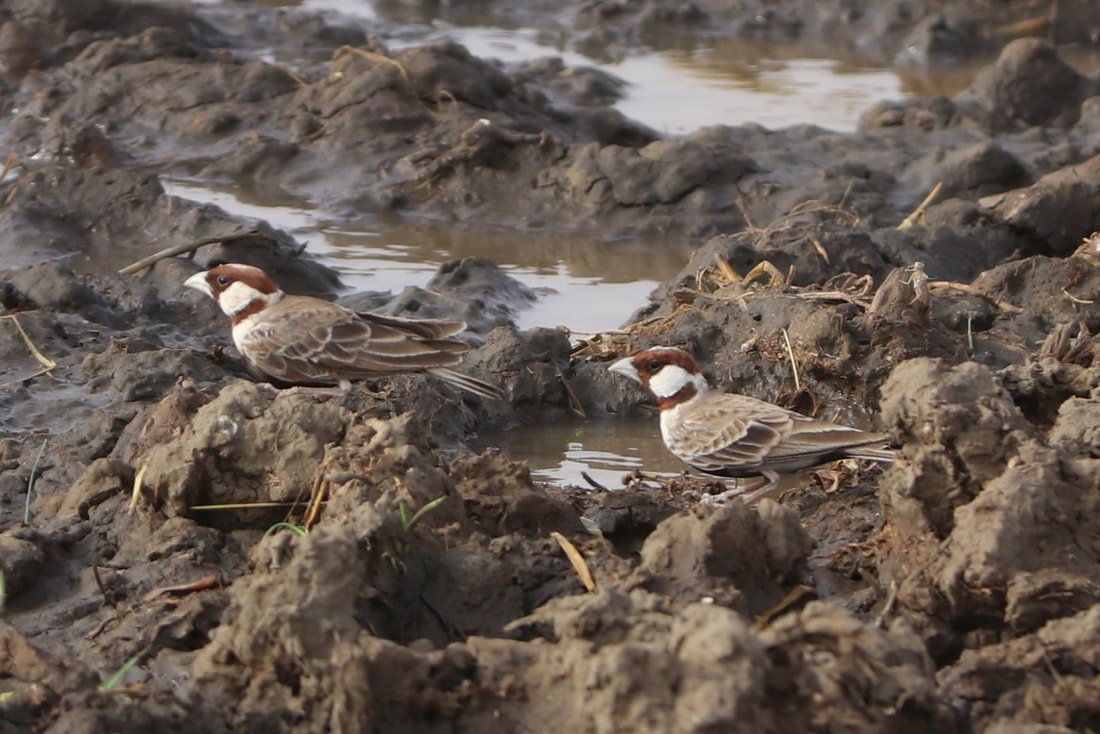
Returning to this original meaning, and discarding attempts to colonize peoples’ sense of beauty, the aisthētikós experience of birdsong is perhaps our oldest sensual and sonic experience. One can imagine us, early homo sapiens, on the Horn of African listening intently to the songs of birds such as the white-winged collared dove and the chestnut-headed sparrow-lark, developing our emerging sense of rhythm and pitch (so different from other great apes). In many ways, our musical brain is more like bird-brains than ape-brains.

In a Thesis exploring ecologically literate vocal repertoire, Evan Snyder highlights a number of composers in the classical tradition that have been influenced by the natural environment—John Luther Adams, Stephan Lias, Derek Charke, Judith Cloud, and Catherine McMichael. Though this study was limited by its focus on classical music, each composer studied reflects different experiences with nature and relationships to environmental issues. This can be particularly important for teachers.

One piece Snyder points readers to, and which I suggest giving a close listen to, is Oikos/Ecos by Derek Charke, which is strange and uncomfortable, revealing “society’s preferences for digital fantasy over ecological reality.” Discomfort is part of many learning experiences. For instance, Kallio and Westerlund suggest discomfort is essential for intercultural learning in music teacher-education. If it is uncomfortable to consider the musicking ways of other cultures, how much more might it be uncomfortable to consider the musicking of non-human beings, and our own ecologically destructive ways? I find Oikos/Ecos particularly interesting as an approach to musicking because this compositions makes me want to escape it; to be outside listening to my finches and sparrows, refilling their birdseed and living in a less-"crumbling" time. Now! It feels urgent. I want to sense, aisthētikós, bird-brains  more than I want to reside in the "stolen" intelligence of human society. And so this uncomfort becomes motivation to leave the house and sense.

DS 
 
Link to image of chestnut-headed sparrow-lark: https://upload.wikimedia.org/wikipedia/commons/7/77/Eremopterix_signatus.jpg
0 Comments

Thoughts on the Eco-Daoist View

3/3/2021

2 Comments

 
Picture
Post 76.

“The course and nature of things is such that
What was in front is now behind” ~Lao-tsu

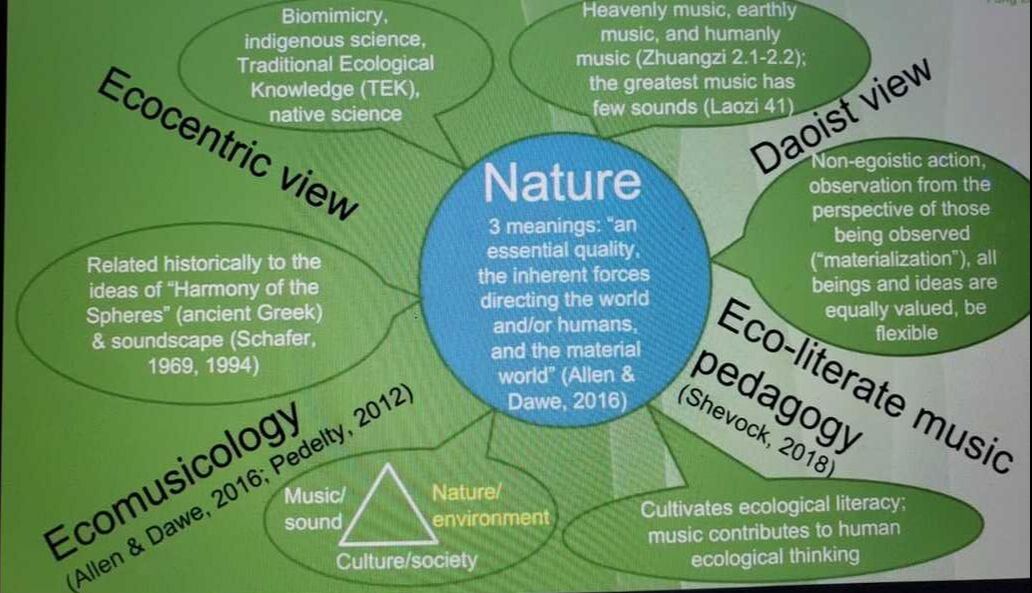
In sharing his philosophical research at the 2021 NAfME Conference, Victor Fung used Confucian and Daoist philosophy to clarify two approaches to thinking about music education, the anthropocentric and the ecocentric. The anthropocentric view, which Fung links to John Blacking’s definition of music as “humanly organized sound,” has dominated music education discourse.

But a more ecocentric view, that centers nature, can be found in the work of Ecomusicologists and in my conception, Eco-Literate Music Pedagogy, and treats humans as one musicking being in a diverse world. (I took this photo of a slide from Fung’s presentation, which I think does an excellent job bringing together these diverse strains.) The focus of music education in this ecocentric view draws our attention to diverse concepts such as soundscapes, biomimicry, indigenous science, Traditional Ecological Knowledge, native science. Musics contribute to human ecological thinking, and Fung connects this understanding to the Daoist view: “Non-egoistic action, observation from the perspective of those being observed (“materialization”), all beings and ideas are equally valued, be flexible.” Fung ultimately recommends an approach that is both Anthro-Confucian and Eco-Daoist.

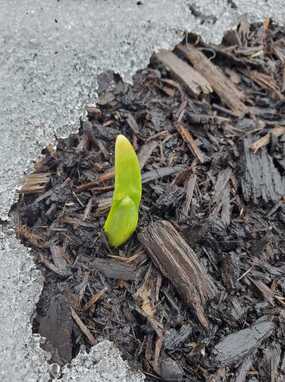
My interpretation: Like my photo (above) of the emerging flowers as winter gives way to Spring, I think it is time for the ecocentric perspective to come around. One thing I especially appreciate about Fung’s philosophical work (in his description of the Daoist-view) is non-egoistic action, and the levelling of hierarchies: all beings and ideas being equally valued. I have no particular expertise with Daoist thought, so I very well may misinterpret some of this. I have read the Lao-tsu (referenced above) but have not yet read Zhuangzi (the other Daoist thinker Fung references). By centering ecosystems, humans don’t disappear (as Fung clarified in a later slide); the human resides within the ecosystem. Humans are considered in the ecocentric view. But non-human beings are also considered in this approach (and often not in the anthropocentric view); often non-human beings (animals, plants, natural processes) are considered first to counterbalance the anthropocentric position, which has long dominated in music education philosophy. Hierarchies are leveled, and these hierarchies, which in the anthropocentric approach have placed humans above animals, men above women, White folk above Black folk, heteronormative folk above LGBTQ+ folk, are resisted. As written in the Lao-tsu (quoted above), what is in front is now behind. If humans take our moment of being “in front” as a chance to dominate and to destroy, our eventual moment of being “behind” might equally, and tragically, mean our own domination and destruction. Even if it didn't, domination and destruction are intrinsically bad, and we've dominated and destroyed (sometimes even while mouthing the word "stewardship") for far too many years.

DS
 

Picture
2 Comments

Reboot

3/2/2021

0 Comments

 
Picture
Post 75

Reboot

Thinking About Band

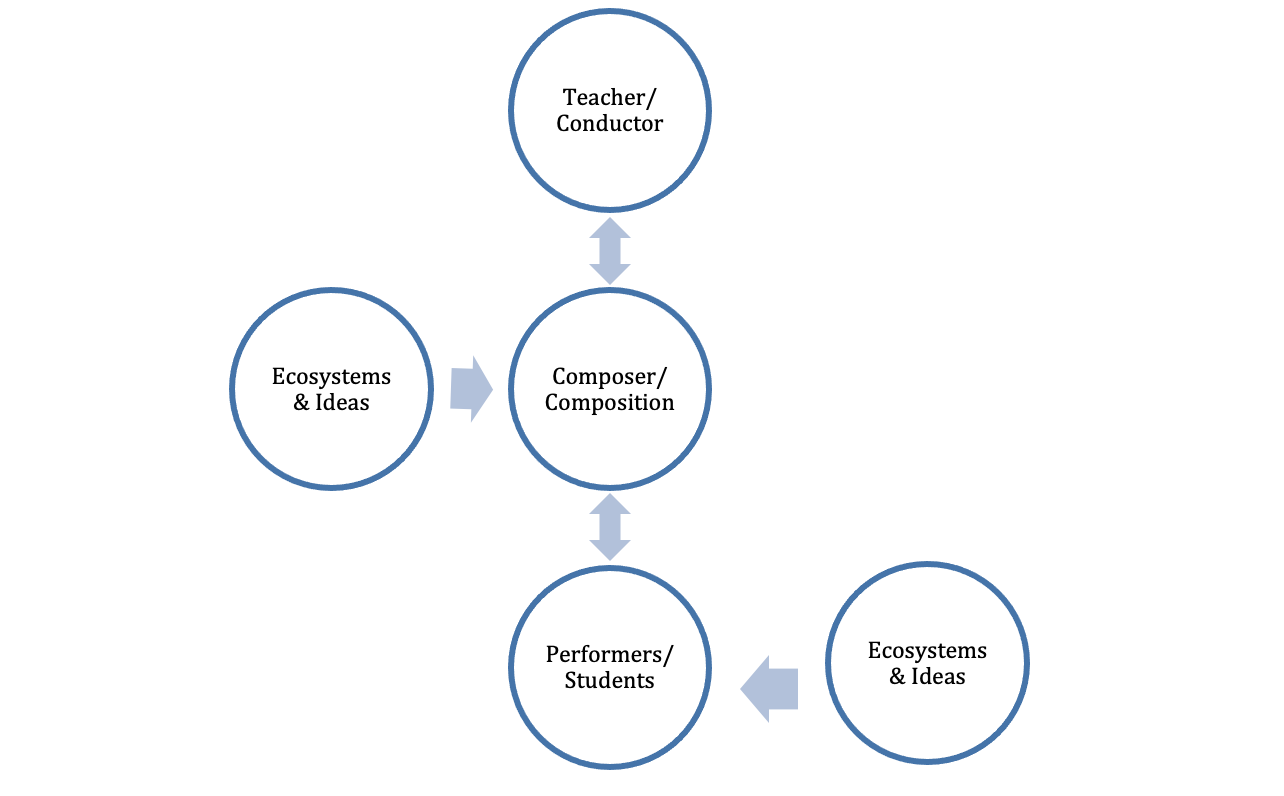
This morning I'm thinking about school concert band (though the approach represented by these thoughts might be useful for school marching and jazz bands too). A primary way school bands can teach for eco-literacy may be by beginning with program notes. Dave Maslanka’s oeuvre can serve as a wonderful model for this approach. When we read Maslanka’s program notes, it quickly becomes apparent that merely playing the right notes is not enough in performing this music well. He writes with forceful ecological purpose, and that purpose should serve as a springboard for students performing his music in concert band. There are many composers whose music expresses various ecological ideas and politics. Beginning with a horizontal approach—from the composer’s intentions to teacher/conductor performers/students—can serve as a springboard for conversations that matter and that can broaden experience and understanding. But even when programming composers with less of an overt ecological barometer, ecological literacy can be approached by extending laterally, beginning with the programmed musics and making connections to ecological challenges students face in society every day.


Even after beginning horizontally, with ecologically minded composers, since the lateral approach is how those composers generated their insight, their inspiration for composing; guiding students as they think laterally may better to help them think like a creative musicians working within a society. In this model, the teacher/conductor plays an important role, guiding student learning through the composition, which represents the composers intentions, where ecosystems & ideas affected the composer. Additionally, the teacher/conductor guides the students as they come upon these ideas through the composition, as well as they bring in their own horizontal experiences with ecosystems and ecological ideas.

I borrow this idea of horizontal and lateral relationships from Bennett Reimer (2009, p. 12), even where I reject his idea that meaning lies ONLY in horizontal relationships. How could it only reside in this type of relationship? Rather, meaning lies in both sets of relationships, the horizontal and the lateral. Students don’t exist without their horizontal experiences, even those outside of school. Perhaps, especially those. To ignore these misses the most basic element of teaching: caring relationships. Additionally, if we want to emphasize horizontal relationships, and center them, which I do as a teacher, that doesn’t lessen the importance of horizontal relationships. As a result, music ensemble teachers have more duty than merely picking compositions they personally like, which they often label as having aesthetic quality (which cannot then be defined), though picking beautiful and moving pieces is a good idea; music ensemble teachers also have a duty to pick music that provides robust musical, social, and ecological value. By that, I mean musics that serve as a springboard for understanding. For learning. Am I asking too much of music pieces? Of composers? I don’t think so. I’ve already pointed toward Maslanka’s music as a model, and that’s for a reason. This music is aesthetically moving, as well as being socially and ecologically robust. Scheduling a Maslanka composition on a concert ought to be an opportunity for technical, artistic, and mental growth, as teachers and students wrestle simultaneously with wondrous and complex sounds and social and ecological meaning throughout the school year. Musicking of this sort deserves centrality to any educational system.

DS


0 Comments
Forward>>

    Eco-Literate Pedagogy Blog

    Daniel J. Shevock

    I am a music education philosopher. My scholarship blends creativity, ecology, and critique. I authored the books Eco-Literate Music Pedagogy, and, with Vince Bates, Music Lessons for a Living Planet: Ecomusicology for Young People, both published by Routledge. Through my blog at eco-literate.com I wrestle with ideas such as nature, sustainability, place, culture, God, race, gender, class, and beauty. I currently teach music at Central Mountain Middle School, in Mill Hall, PA, USA, in rural central Pennsylvania.

    Archives

    May 2026
    February 2026
    January 2026
    December 2025
    June 2025
    May 2025
    January 2025
    December 2024
    November 2024
    October 2024
    August 2024
    July 2024
    May 2024
    July 2023
    May 2023
    April 2023
    January 2023
    December 2022
    April 2022
    October 2021
    August 2021
    July 2021
    June 2021
    April 2021
    March 2021
    December 2019
    November 2019
    October 2019
    September 2019
    August 2019
    July 2019
    June 2019
    May 2019
    April 2019
    March 2019
    February 2019
    December 2018
    November 2018
    October 2018
    September 2018
    August 2018
    April 2017

    Categories

    All

    RSS Feed

Powered by Create your own unique website with customizable templates.
